



Uma análise sem falhas e comparável relaciona-se estreitamente com um manuseio preciso da amostra. Somente uma amostra representativa do material inicial pode gerar resultados de análise significantes. Amostradores garantem a representatividade da amostra e, consequentemente, a reprodutibilidade da análise. Os amostradores RT são ideais para a redução local do material da amostra. São fáceis de usar e de limpar e não requerem conexão elétrica.
Vantagens do Produto
- Divisão exata de quantidades maiores
- Design modular
- Proporção de divisão ajustável
- Extração de 1 a 3 amostras
- Saídas de amostra de liberação rápida e fácil fixação do cone inferior
- Possibilidade de operação em lotes ou contínua
- Tubo rotativo com velocidade controlada
- Conexão digital direta para alimentador vibratório DR 100
- Processo de divisão segundo DIN 51701
Exemplos de aplicação
clínquer de cimento , produtos químicos , café , Materiais de construção, fertilizantes , cargas , farinhas , cereal , pó metálico, minerais , nozes , areia , sementes , solos , sabão em pó ,..
Princípio de funcionamento
O material a ser amostrado passa pelo funil alimentador através da canaleta do alimentador vibratório para dentro do tubo amostrador rotativo. O tubo rotativo dentro do cone superior distribui o fluxo total de material por igual a uma velocidade constante (50 rpm) ao longo da circunferência de referência do cone inferior. Os cones inferiores intercambiáveis podem ter uma, duas ou três fendas de amostra ajustáveis sem escalonamento. A cada rotação uma quantidade equivalente à largura da fenda é separada e depositada no vaso coletor. O restante passa para o coletor de refugos.
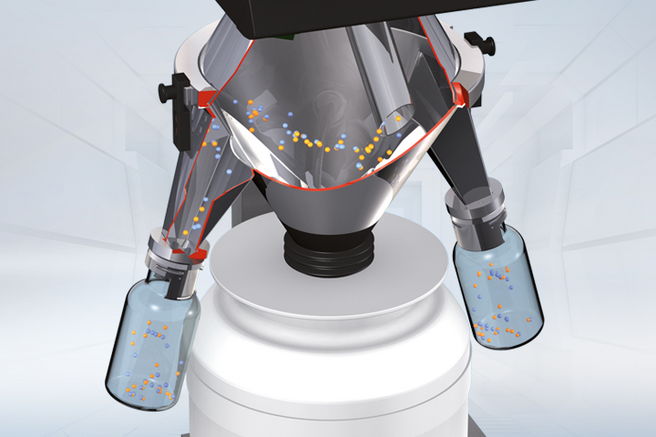
Amostrador de tubo rotativo PT 200 Dados Técnicos
| Applications: | sampling, sample division, sample reduction |
|---|---|
| Field of application: | agriculture, biology, chemistry / plastics, construction materials, engineering / electronics, environment / recycling, food, geology / metallurgy, glass / ceramics, medicine / pharmaceuticals |
| Feed material: | bulk materials |
| Material feed size: | <= 10 mm |
| Rotary speed | 50 min-1 |
| Number of divisions: | 1 / 2 / 3 (depending on bottom cone) |
| Time setting: | digital, 1, 3, 5, 10 - 60 min / continuous operation |
| Slot width, continuously adjustable: | 0 - 159 mm (1 sample outlet) 0 - 110 mm (2 sample outlets) 0 - 53 mm (3 sample outlets) |
| Max. dividing ratio : | 1 x 1:5 (1 sample outlet) 2 x 1:7,2 (2 sample outlets) 3 x 1:15 (3 sample outlets) |
| Min. dividing ratio: | 1 x 1:26 (1 sample outlet) 2 x 1:26 (2 sample outlets) 3 x 1:26 (3 sample outlets) |
| Volume of reject collector: | 26 l |
| Container volume: | 250 ml / 500 ml |
| Electrical supply data: | 100-240 V, 50/60Hz |
| Power connection: | 1-phase |
| W x H x D: | 520 x 1050 x 551 mm / 572mm x 1307 x 551 incl. DR 100 |
| Net weight: | ~ 46 kg (incl. DR 100) |
| Standards: | CE |
Amostrador de tubo rotativo PT 200 Downloads
General Catalogue

Product data sheet PT 200
Product Overview
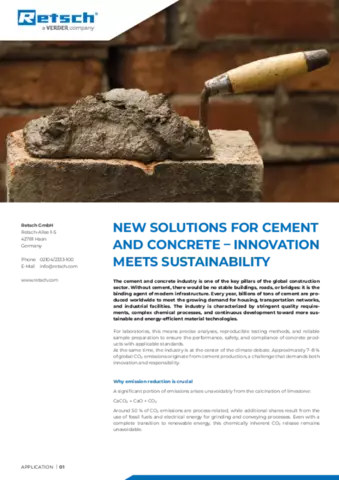
New Solutions for Cement and Concrete
The cement and concrete industry is one of the key pillars of the global construction sector. Without cement, there would be no stable buildings, roads, or bridges: it is the binding agent of modern infrastructure. Every year, billions of tons of cement are produced worldwide to meet the growing demand for housing, transportation networks, and industrial facilities. The industry is characterized by stringent quality requirements, complex chemical processes, and continuous development toward more sustainable and energy‑efficient material technologies.
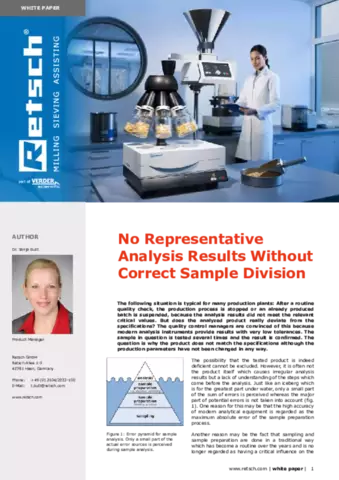
No Representative Analysis Results without Correct Sample Division
Faultless and reproducible analysis results are closely linked to an accurate sample handling. Only a sample representative of the initial material can provide meaningful results. Rotating dividers and rotating tube dividers are an important means to ensure the representativeness of a sample and thus the reproducibility of the analysis.