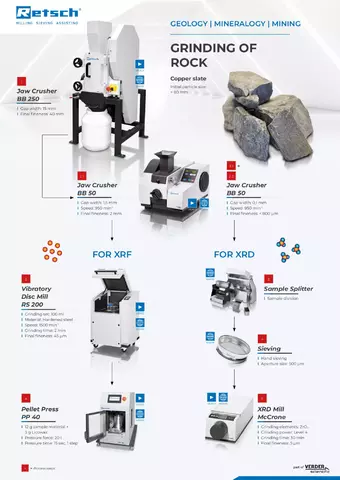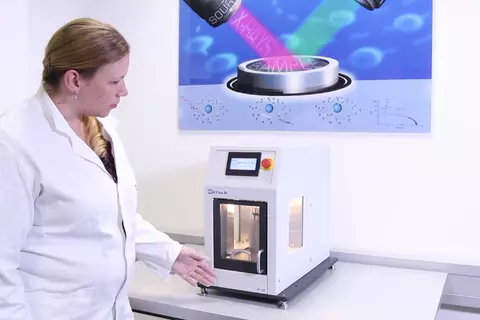



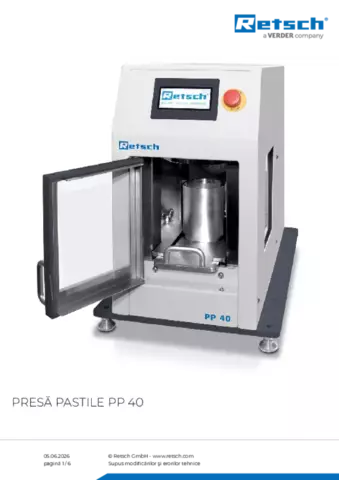
Solid, high-quality pellets are an important precondition for reliable and meaningful XRF analysis. With the PP 40, RETSCH offers a pellet press which produces strong pellets with a smooth surface. The PP 40 features individual pressure force regulation in the range of 0 to 40 t. It combines the advantage of a small benchtop unit with high press forces, which are built up automatically in three steps, ensuring that even difficult materials are pressed perfectly.
Avantaje Produs
- model potrivit pentru masa de lucru
- ajustare individuală a forței presiunii de până la 40 de tone
- presare în inele de oțel, cupe de aluminiu sau liberă
- instrumente de presare pentru diametre variate
- 10 POS pot fi definite și memorate pentru aplicațiile de rutină
- setare facilă a parametrilor prin intermediul ecranului tactil
- control automat al forței presiunii
Stabilizing pressed pelletts
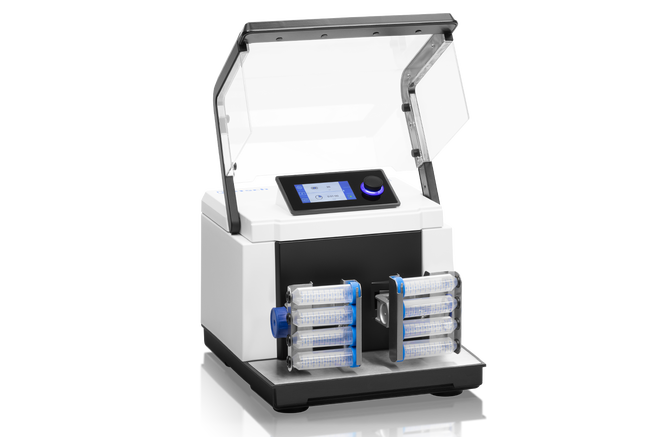
Applying, for example, forces of 10 tons, 20 tons, and 30 tons in sequential steps, each with a 20-second hold time, proves advantageous for pellet stability as particles have sufficient time to settle. Pressing the pellets in aluminum cups further augments their stability. Should these measures prove inadequate, incorporating a binder, such as Licowax, offers an effective stabilization method for challenging samples, including metal powders. Typically, a mixture of 10-15 g of the sample with 2 g of Licowax, pressed in three stages as outlined above, yields optimum results. For the mixing process, the Mixer Mill MM 400, equipped with an adapter for holding 8 conical centrifuge tubes, is highly effective. It ensures that samples are mixed uniformly, automatically, and reproducibly.
Presă Pastile PP 40 Exemple de Aplicații
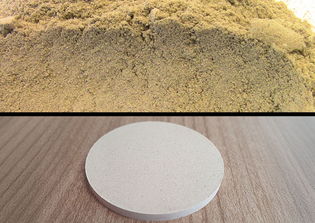
Wood 4g
Particle size 0.25 mm
Pressing tool 32 mm
20 s each at 10/20/30 tons
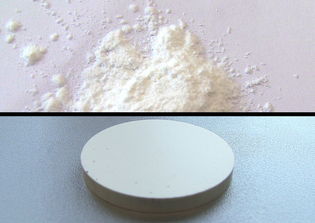
Cellulose 7 g
Particle size 0.15 mm
Pressing tool 40 mm
Aluminum cups 40 mm
30 s each at 10/20/30 tons
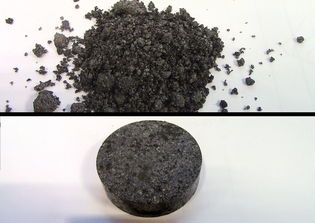
Slag 40 g
Particle size 0.25 mm
Pressing tool 40 mm
20 s 20 tons
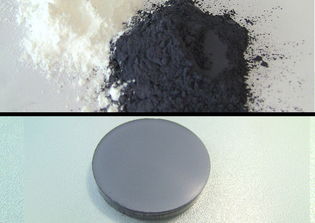
FeSiMg-Granulate 12 g plus 2 g licowax
Particle size 0.10 mm
Pressing tool 40 mm
Aluminum cups
60 s 15/25/35 tons
3 recommendations to obtain reliable XRF results
- Particle size reduction
Pulverize the sample into a fine powder of < 100 µm or less, depending on the element to be detected, before pressing it into a pellet. This size reduction helps mitigate matrix effects, including grain size and texture variations, which can distort XRF results. - Uniformity and homogeneity
Press the sample into a pellet to ensure uniformity and homogeneity. This is crucial for XRF analysis which relies on consistent interaction between the X-rays and the sample to produce accurate and reproducible results. Homogeneity guarantees that the results represent the entire sample. - Enhanced analytical precision and accuracy
Create a dense and uniform pellet with a smooth and flat surface to enhance precision and accuracy of the XRF analysis. A smooth surface ensures consistent X-ray penetration and reduces the scatter, thereby improving the quality of the analytical results.
Benefits of pellet pressing for XRF analysis
Due to its ability to produce homogeneous, stable, and accurate samples efficiently and cost-effectively, pellet pressing is a widely adopted method for preparing samples for XRF analysis.
- Stability and handling
Pellets are more stable and easier to handle compared to loose powders. This stability is particularly important for samples that might be hygroscopic or prone to segregation. Once pressed, the pellet can be easily placed into the XRF instrument for analysis without the risk of sample loss or contamination. - Minimum use of chemicals
Compared to other sample preparation methods such as fusion, pellet pressing requires no or minimal additional chemicals. This reduces the risk of introducing contaminants that could interfere with the analysis. - Cost-Effectiveness
Pellet pressing is a relatively simple and cost-effective method of sample preparation, especially when compared to more complex methods such as fusion. The fact that it requires less specialized equipment and consumables makes it an attractive option for any laboratory.
Presă Pastile PP 40 Date tehnice
| Applications: | preparation of pellets for spectral analyses |
|---|---|
| Field of application: | chemistry / plastics, construction materials, environment / recycling, geology / metallurgy, glass / ceramics |
| Max. pressure: | 40 t, automatic press |
| Pressure force: | 0 - 40 t (1 - 400 kN) |
| Pressure force increase / holding / decrease time: | fix ramp / 1 - 99 s / fix ramp |
| Parameter combinations: | 10 |
| Steel rings (external Ø / internal Ø): | 40 mm / 32 mm (max. pressure force 15 t) 40 mm / 35 mm (max. pressure force 15 t) 51.5 mm / 35 mm (max. pressure force 30 t) |
| Aluminium cup (external Ø): | 32 mm (max. pressure force 25 t) / 40 mm (max. pressure force 40 t) |
| Electrical supply data: | 100-120 V, 50/60 Hz; 220-240 V, 50/60Hz |
| Power connection: | 1-phase |
| W x H x D: | 335 x 495 x 570 mm |
| Net weight: | 120 kg |
| Standards: | CE |
Principiu de funcţionare
Un inel de oțel sau o cupă de aluminiu este poziționată și umplută cu probă în matrița presei PP 40. Întregul ansamblu se introduce apoi sub placa de presare și se inițiază procesul de presare.
Densitatea pulberii crește odata cu creșterea presiunii. Pentru a permite dezvoltarea forțelor de adeziune intre particule, forța maximă de presare trebuie menținută pe un anumit interval de timp. Acest lucru si presarea în trei etape, prin creșterea treptată a presiunii asigură stabilitatea maximă a pastilei obținute.
Supus modificărilor şi erorilor tehnice
Presă Pastile PP 40 Descărcări
Fișă de produs PP 40

General Catalogue

Product Overview